
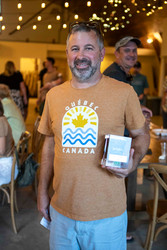
PZW Specialist Spotlight - Toby Alves
Oct 15th 2025
When Toby Alves talks about his work, he returns often to one word: connection. For him, being a Product & Zero Waste Specialist (PZW) at Eco-Products is about connecting people, industries and ideas, turning a daunting challenge like waste diversion into a collaborative success story.
Toby’s path to Eco-Products winds through golf courses, composting facilities, restaurants, and farms. Early in his career, he worked as an assistant superintendent at golf courses, where he came to see firsthand the impact of fertilizers and chemicals and discovered new solutions to environmental concerns. “I learned a lot about managing expectations and making changes in tough environments,” he recalls.
From there, he managed composting programs for municipalities in New England, co-founded a bustling bagel shop in Portland, Maine, and built a vertically integrated food-scrap composting business. Most recently, he has combined those experiences with his work at Eco-Products, where he helps customers keep organic waste out of landfills.
“It is a culmination of 30 years of work,” he says. “I have sat in the composter’s seat, the hauler’s seat, the business owner’s seat. Now I get to pull all of that together and help our customers succeed.”
As a PZW, Toby supports operators across the Northeast. His days are anything but typical. One week he might be walking the dining halls of a university. The next, he is sitting with composters, haulers, or regional sales managers. “In-person site visits are crucial. You can only learn so much on a virtual call,” he explains.
At its core, his work is about building bridges: between foodservice operators and composters, between products and procurement, between composting challenges and sustainability goals. “Sometimes we are simply the coordinators in the room, the ones who know all the players and can help everyone pull in the same direction,” Toby says.
The toughest obstacle Toby encounters is contamination in the organics stream. Non-compostable items, whether mislabeled products or plain old trash, can derail even the best-intentioned programs.
“Solving contamination is the No. 1 challenge in our industry,” he says. “Compostable products work. They break down. The real hurdle is keeping everything else out.”
He combats misconceptions head-on. Many people assume composting infrastructure does not exist in their region. “That is simply not true,” he says. “Your trash may already be traveling hundreds of miles to a landfill. If your compost has to go 50 miles away from you, that is still a better solution.”
Among the many projects he is proud of, Princeton University stands out. Eco-Products worked with the school to replace disposables in its main dining hall with certified compostables, which were then processed on campus. “It became both a social experiment and part of Princeton’s curriculum,” Toby says. “We tested bin designs, locking systems, and messaging. Now, food scraps and packaging are composted right on campus, and students are studying it in their classes. That is pretty rewarding.”
He is also energized by creative solutions, like small farms that use animals to pre-treat food scraps. “Anytime animals are involved in managing food waste, I am happy,” he says.
For Toby, the importance of composting goes far beyond waste diversion. “If we do not figure out how to treat organics as a resource, there are real challenges ahead,” he says.
With his agricultural background, Toby sees compost as critical to restoring soils, reducing erosion and supporting sustainable food systems. “I am optimistic,” he says. “The momentum is here. There is demand for the finished product, and smart people are working hard on solutions.”
And while Toby is quick to highlight the seriousness of the work, he also emphasizes the fun. He describes himself as a “conference nerd” who loves swapping ideas at industry gatherings. He admits he still gets excited talking about composting after decades in the field. “We have had setbacks, sure, but I have not found it difficult to lace up my shoes the next day. I still love the challenge.”
When asked what advice he gives to customers starting out with compostables, Toby keeps it straightforward: “Start slow and manage expectations. Make it easy for your staff and your guests. If everything they are holding is certified compostable, they do not have to think twice about what bin it goes in. That is when the programs really work.”
At the end of the day, Toby believes the biggest opportunity lies in collaboration. “The most rewarding part is working with colleagues and composters I have known for years, and realizing my job is to help them succeed,” he says. “It feels pretty incredible.”


Fun Facts
Grew up in: Hillsboro, N.H.
First job: Grounds crew at his grandparents’ golf course
Favorite place traveled: Costa Rica
Fun fact: He loves industry conferences, especially composting and recycling ones
Hobbies: Farming
Three words that describe his job: Challenging, rewarding, fun
If he could instantly master a skill: Playing any musical instrument
If he could fix one waste-related problem: Contamination in the organics stream