
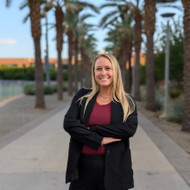
PZW Specialist - Krista Keisu
Posted by Eco-Products on Nov 3rd 2026
When Krista Keisu was in elementary school, she learned a frustrating early lesson about recycling. After she and her classmates were encouraged to separate recyclables from trash, she watched as both were collected and dumped into the same dumpster.
The experience stuck with her.
“I started wondering what actually happens after we put something in the recycling bin,” she recalls. “It made me realize you can’t always take things at face value. I wanted to understand how the whole system worked.”
Today, Krista helps businesses answer those same kinds of questions as a Product & Zero Waste Specialist (PZW) at Eco-Products. She works with foodservice operators to make sense of recycling and composting requirements and develop practical waste reduction programs.
“I really love getting out into the community, talking to people, listening to what their challenges might be and trying to creatively solve problems,” she says.
Growing up near the Chesapeake Bay in Southern Maryland, Krista spent much of her childhood outdoors. School field trips introduced her to the Bay’s waterways, wildlife and ecosystems, helping nurture an interest in the environment that eventually led her to study Environmental Studies at Eckerd College in St. Petersburg, Fla.
After graduating from Eckerd College, Krista worked on environmental education and sustainable landscaping projects before earning a master’s degree in Sustainability Leadership from Arizona State University (ASU).
She went on to spend five years as Sustainability Manager for Sun Devil Hospitality, ASU’s dining services, leading waste reduction efforts across four campuses. Her work included helping transition more than 774,000 single-use plastic items to compostable alternatives in 2024–2025.
While at ASU, Krista worked with an Eco-Products PZW and saw firsthand how the role helped foodservice operators overcome waste reduction challenges. That experience eventually led her to join Eco-Products herself.
Krista now supports customers across a large territory that includes Alaska, Arizona, Washington, Oregon, Colorado, New Mexico, Wyoming, Montana, Idaho and southern Nevada.
She understands that foodservice operators have plenty of competing priorities. Waste reduction can seem complicated, especially when recycling and composting rules vary from one community to another.
Her goal is to make the process easier.
“A big part of my role is helping take the uncertainty out of waste diversion decisions,” she says.
That might mean helping a customer understand what a local composter accepts, choosing appropriate foodservice products, creating clearer waste station signage or developing employee training.
Krista emphasizes that even a well-designed program needs ongoing attention. Employees must understand how the system works, and customers need to know which bin to use. Her advice to businesses getting started is to learn what local infrastructure is available, find the right partners and begin with manageable steps.
“Things take time, and progress can be quite incremental,” she says. “You have to keep learning what works and be willing to adjust along the way.”
Krista is particularly passionate about composting and keeping food waste out of landfills. She believes foodservice operators can better appreciate its value when they consider all the time, effort and resources that go into growing and preparing food. Reducing food waste is always the first priority, but when food can’t be eaten or donated, composting offers a way to put those resources to good use.
She also sees opportunities for businesses, municipalities, waste haulers, composters and manufacturers to work more closely together, helping more food waste and other organic materials reach facilities that can process them.
“I think building stronger partnerships between all these groups can help create a more resilient system,” Krista says. “It’s about everyone working together and communicating toward a common goal.”
If she could take a foodservice operator anywhere to better understand waste reduction, Krista would choose two places. The first would be a landfill, where they could see what happens to discarded materials. The second would be a composting facility or a farm using finished compost, where they could see how food scraps and other organic materials can become a valuable resource.
It’s that second destination that she finds especially inspiring, showing how materials that might otherwise end up in a landfill can help grow more food and support healthier soils. For Krista, the possibilities go beyond simply keeping waste out of landfills. She sees an opportunity to rethink how materials are used and create systems that work more like the natural world.
“In nature, everything has a purpose and becomes a resource for something else,” she says. “I think we need to start looking at what we throw away the same way.”


Fun Facts
Grew up in: Maryland, near the Chesapeake Bay.
First job: I worked as an administrative assistant for my grandfather’s heating and air conditioning business, helping customers schedule service appointments.
Favorite place traveled: Peru. I had the opportunity to visit Machu Picchu, explore the Amazon rainforest and see the country’s coast.
Three words that describe her: Passionate, creative and empathetic.
What do you enjoy doing outside of work? Hiking, climbing, paddleboarding, gardening, foraging, spending time with family and friends, and traveling to new places. I especially enjoy exploring different cultures through food.
Something people might not know about her: I’m a certified Western herbalist. I grow herbs and make my own teas, tinctures and salves.