
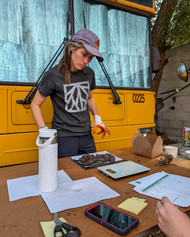
PZW Specialist Spotlight - Meghan Ibach
Feb 17th 2026
For more than a decade, Meghan Ibach has been guided by one focus: bringing food, sustainability, and community closer together. From managing a farm-to-table restaurant to leading campus dining programs and building community gardens, she has always been drawn to projects that connect people to the impact of what they eat and what they throw away.
Today, as a Product and Zero Waste Specialist at Eco-Products, she brings that experience to helping businesses and institutions keep food scraps and compostable packaging out of landfills.
Her work is both practical and strategic. She spends much of her time with foodservice operators, composters and haulers, helping design systems that reduce waste while keeping daily operations manageable.
“The most rewarding part is when it finally comes together,” she says. “These projects can take years. But when you see food waste going to the right place, packaging breaking down in compost and a team no longer struggling, it’s incredibly satisfying.”
One example came at the Eldora Mountain Resort in Colorado. After losing their hauling service, the resort’s staff spent an entire season collecting food scraps in buckets and driving them to a transfer station. Meghan helped connect them with a hauler in Denver that could take both their food waste and compostable packaging.The result was a program that saved staff hours of labor and significantly improved diversion rates.
Another project she proudly recalls happened at the Four Seasons in Vail, Colo. The hotel used four cases of oranges a day for fresh juice, and all the peels were going into the trash. “They knew it was a problem but weren’t sure how to start,” she says. Meghan worked with them to set up a system that captured the peels for composting.
“It started with oranges, but it grew from there,” she says. “Seeing that change take root was really rewarding.”
Her path to Eco-Products grew from a series of roles that deepened her expertise in food systems. In Asheville, N.C., she worked with Mountain Food Products to connect chefs and restaurant owners with regional producers, then managed Homegrown Eatery, a restaurant focused on local sourcing. At UNC Asheville, she became Sustainability Coordinator and later Marketing Manager for Dining Services, leading efforts on food waste, local procurement and climate-friendly dining.
Her career also includes two years with La Puente Home in Colorado, where she directed community garden programs and built education initiatives for local schools.
“Those early experiences showed me how communities respond to sustainability efforts, and how much education can shift behaviors,” she says.
At Eco-Products, Meghan applies all that knowledge to the challenges of composting. She knows that building trust is one of the most important parts of her job.
“There’s so much confusion in the market, and so much greenwashing. Matter matters even more complicated, every community has different infrastructure and different rules,” she says. “I want composters to know we’re here to support them and to make sure our products aren’t a source of contamination.”
That emphasis on contamination is central. “Even a fruit sticker can reduce the value of compost,” she says. “It’s not like recycling, where decades of technology have been built to separate good material from trash. In composting, contamination is incredibly hard to remove. Getting a clean waste stream from the start is everything.”
Despite those challenges, she is optimistic about the future. She sees a new generation of composters entering the field, often starting small before scaling up into full facilities. “They’re scrappy, they’re committed, and they care deeply about producing something valuable for their communities,” she says.
For Meghan, the most rewarding part is seeing it all come together: when the staff is freed from hauling buckets of food waste, for example, or when a hotel finds a way to compost thousands of orange peels.
“It takes patience and persistence,” she says. “But when the system works, it changes how people see waste. And that’s when real progress happens.”


Fast Facts
Grew up in: Charlotte, N.C.
First job: Ben & Jerry's scoop shop
Fun fact: One of six kids
Hobbies: Trail running, snowboarding, gardening, live music, cooking, reading, spending time with friends and dogs
Three words that describe her: Enthusiastic, passionate, caring
Favorite part of her job:Helping people achieve their sustainability goals, whether that’s diverting from landfill or creating clean, finished compost
If she could master one skill instantly: Persuading people to care about the future and convincing them that their actions today matte
Biggest bucket list item: Backpack the Haute Route from southern France to Switzerland
Strangest thing found in a compost bin: A bowling bowl
Biggest pet peeve: "Wishcycling"—tossing things in the binhoping someone will figure it out
Dream work location for a month: The Alps (Switzerland, Italy, Austria)